
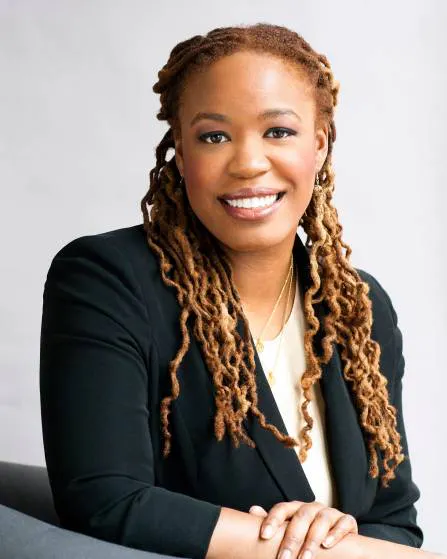
Defining a new us with Heather McGhee
FEBRUARY 17TH, 2021

Interviewee: Heather McGhee
Background: Author and economic and social policy expert
Topic: Defining a new us
Listen: On the web, Apple, Spotify, RSS
“As long as we’re divided, we’re conquered. Solidarity dividends [are] these things that we can gain through collective action across lines of race that we can’t do on our own. Higher wages, cleaner air, better funded schools. That’s the new economic model, but we need to pursue the idea only through solidarity.” — Heather McGhee
On live television in 2016, something extraordinary happened.
It was a call-in show on C-SPAN. The guest was Heather McGhee, an economic policy expert. During a conversation on tax policy, a man called in, identified himself as white, and announced he was prejudiced. After sharing his views, he wanted to know what the guest — meaning Heather — thought he could do to change and be a better American. That moment, and Heather’s thoughtful response that went viral, are worth watching.
The Sum of Us is Heather’s McGhee’s fantastic new book on the economic costs of racism that’s out today. The book balances well-argued research using her economic and legal backgrounds with on-the-ground reporting that reads like a novel. The book raises the critical question of how we define “us” and the costs of doing so unjustly. It’s nothing short of excellent.
Heather is on the rise in a big way. Her ideas and language are showing up in Joe Biden’s speeches, she’s doing a book event with Elizabeth Warren, and she’s a policy force in progressive politics whose influence will only grow from this book. I’ve been lucky to know Heather over the years and I was honored to talk about the costs of racism and how to define “us” in the 21st century. I highly recommend listening to our conversation in full as a podcast on the web, through Apple, or on Spotify. You can read a condensed transcript below.
YANCEY: You write: “Racism drains the public pool of America: public goods are seen as worthy of investment only as long as the public is seen as good.” Can you talk about the drained pools?
HEATHER: In the early 20th century the [United States] went on a building boom of public pools. These were not your backyard pools, these were big grand resort-style public pools that could hold hundreds, even thousands, of swimmers. They were this charming commitment of the government to what we now know to be the American Dream of leisure life. People could count on government to provide not just the necessities, as it had in the New Deal, but also things that make the good life.
And yet like much of the New Deal and like much of government largesse at this time, it was for whites-only in many parts of the country. In the 1950s black communities began to say this is a public good that’s paid for with public tax dollars including our own. As the courts began to side with black communities, towns across the country — not just in the South — decided to drain their public pools rather than let black families swim too. They literally backed up trucks, poured dirt in, seeded it with grass, and by the time the summer came along, it was green.
I walked the grounds at one of these sites, this beautiful park in the middle of Montgomery, Alabama, that used to have a huge, gorgeous resort-style pool. It had a zoo. And as soon as integration was threatened, the town closed the park and sold off the animals in the zoo. In fact, the entire Parks and Recreation Department of Montgomery stayed closed for a decade. No parks, no senior centers, no recreation centers, no pools, nothing for anybody because we don’t want to share. That was replicated across the country.
There’s a connection between these literal pools and the pool of resources. There’s an unbelievable statistic I found: in the late 1950s and early 1960s, two thirds of white Americans thought that we ought to have a job guarantee and universal basic income. They were New Deal white folks who had benefited from strong government investments and expected more of the same. Between 1960 and 1964 white support for those ideas dropped in half from nearly 70% to 35%, and it’s stayed low ever since. What happened between 1960 and 1964? The March on Washington, where of the ten demands, two of them were about a jobs program and a minimum income. By the next election cycle white people would leave the Democratic Party to this day forever.
YANCEY: You write about the people in the new labor movements like Fight for $15, which raised the minimum wage. You quote one fast food worker saying: “I’ve seen the power of coming together and organizing and how it can make change. And I’ve definitely lived the life of when we were not organized… and how life deteriorated over the years.” Why do you think this is happening now?
HEATHER: We’re in a moment where the economic bargain is just not adding up for more and more people. People are feeling like there’s no more to give. You can’t get blood from a turnip. There’s just no more bottom. I looked deeply into what’s going on in American manufacturing and just how much has been lost. Over 40,000 factories. It’s just absolute geographic devastation. You drive through parts of the country where there’s just huge carcasses of factories and all the jobs and dreams that used to live inside them. Then you see how the jobs that have replaced them and have remained are just getting worse and worse. We still have not raised the federal minimum wage over $7.25 an hour. The tipped minimum wage is $2.13. This is criminal and in fact has its roots in slavery. Working people have been pushed and pushed and pushed. Even in a society that overwhelmingly tells them you’re paid what you’re worth, there’s a strict hierarchy of human value. You’re at the bottom of the barrel. If you want to work your way up, great, but don’t expect the bottom of that barrel to lift up…
But as this fast food worker named Bridget told me, as long as we’re divided, we’re conquered. And so I began to see what I call solidarity dividends: these things that we can gain through collective action across lines of race that we simply can’t do on our own. Higher wages, cleaner air, better funded schools. That’s the new economic model, but we need to pursue the idea only through solidarity.
YANCEY: Is there a different notion of how people see themselves or is this about necessity?
HEATHER: Necessity is the mother of invention, so I think necessity invites you to break out of old paradigms. It’s the individual necessity but recognizing that you can’t get there on your own. It’s both and. The only way is through relationships. Once you create those relationships it creates bonds of solidarity that go beyond wages. I talked to this auto worker in Mississippi who talked about what it was like when he would go to the worker center where the people who were pro-union would come after their long shifts to get organized. He said, “I felt a sense of belonging, of love and togetherness and friendship. We went through a lot together and did a lot together and accomplished a lot. I loved it. I loved going over there. It was utopia.” That’s not just about healthcare and a few more dollars an hour. That’s about feeling human connection.
YANCEY: The smallest word in your book title is “us,” but it’s actually quite a big word. How do you define your us?
HEATHER: That’s such a good question. I’m a really unlikely patriot. I was born in the Midwest and I have this feeling that there’s just a deep goodness about this project called America that has been so flawed and yet holds so many ideals in it. My optimism comes from the fact that we were founded as a nation of many nations, a brutal hierarchy mapped onto that diversity. That was a mistake and that was wrong and that can still be righted. Today we have someone living in the United States from every community on the globe. We’re soon to become a nation with no racial majority. The United States, Canada, places where there’s this huge collision of cultures, it’s the New World. Any place like that, to me, has the potential to be this emblematic aspirational version of us. The proximity of so much difference can help us reveal our common humanity. That’s what’s exciting to me about the place where I’ve decided to stay and serve.
LINKS
- The Sum of Us (out today)
- Heather McGhee on Twitter
- Heather’s 2016 C-SPAN appearance
- Listen to our conversation on the web, through Apple, or on Spotify

The Ideaspace
Yancey Strickler's private desktop