
The old shit doesn't work anymore
MARCH 23RD, 2023

Last week I was on the phone with the head of a record label I respect. At the start of the conversation he said he “wanted to be frank.”
“I’m talking to you,” he began, “because the old shit doesn’t work anymore.”
The established patterns for releasing music, going on tour, and putting work into culture, he explained, were no longer relevant. The infrastructure, the audiences, and the money just weren’t there.
“I don’t know where things are going,” he continued, “But I know the old ways aren’t working. When I look at what you’re doing it’s interesting and at least it’s optimistic. So I‘m here.”
This same sentiment, worded slightly differently, has come up more than a handful of times in conversations with musicians, artists, record labels, gallerists, artist managers, and other creative professionals in recent weeks.
Behind these conversations is a fundamental change of the digital age that applies to essentially every creative field: in the past, consumers bought and collected physical editions of creative work, creating a direct value exchange between fans, artists, and producers. Today almost all creative work is digitized and essentially rented — lowering payouts, devaluing work, and redirecting the lion’s share of rewards to the platforms hosting the work rather than the creators themselves.
This change couldn’t be more obvious or widespread, but its downstream effects continue to gain momentum, even now. Industry insider newsletters across creative fields reveal similar trend lines: Box office receipts and payouts from some creator economy platforms are dropping. Touring is more expensive and impractical than ever for artists and fans due to monopolistic rents. Because of AI we may face a post-royalties future for musicians. A musician makes more money selling 10,000 vinyl albums than getting 4,000,000 streams. Netflix now cancels a lot of fan-favorite shows (after being the ones who famously delighted fans by saving Arrested Development). Once-trusted web platforms keep getting worse. Nobody watches music videos anymore. Legacy media coverage has decreasing influence. Indie film producer Ted Hope warns that it’s impossible to make movies like filmmakers used to and we’re heading towards an America without movie theaters.
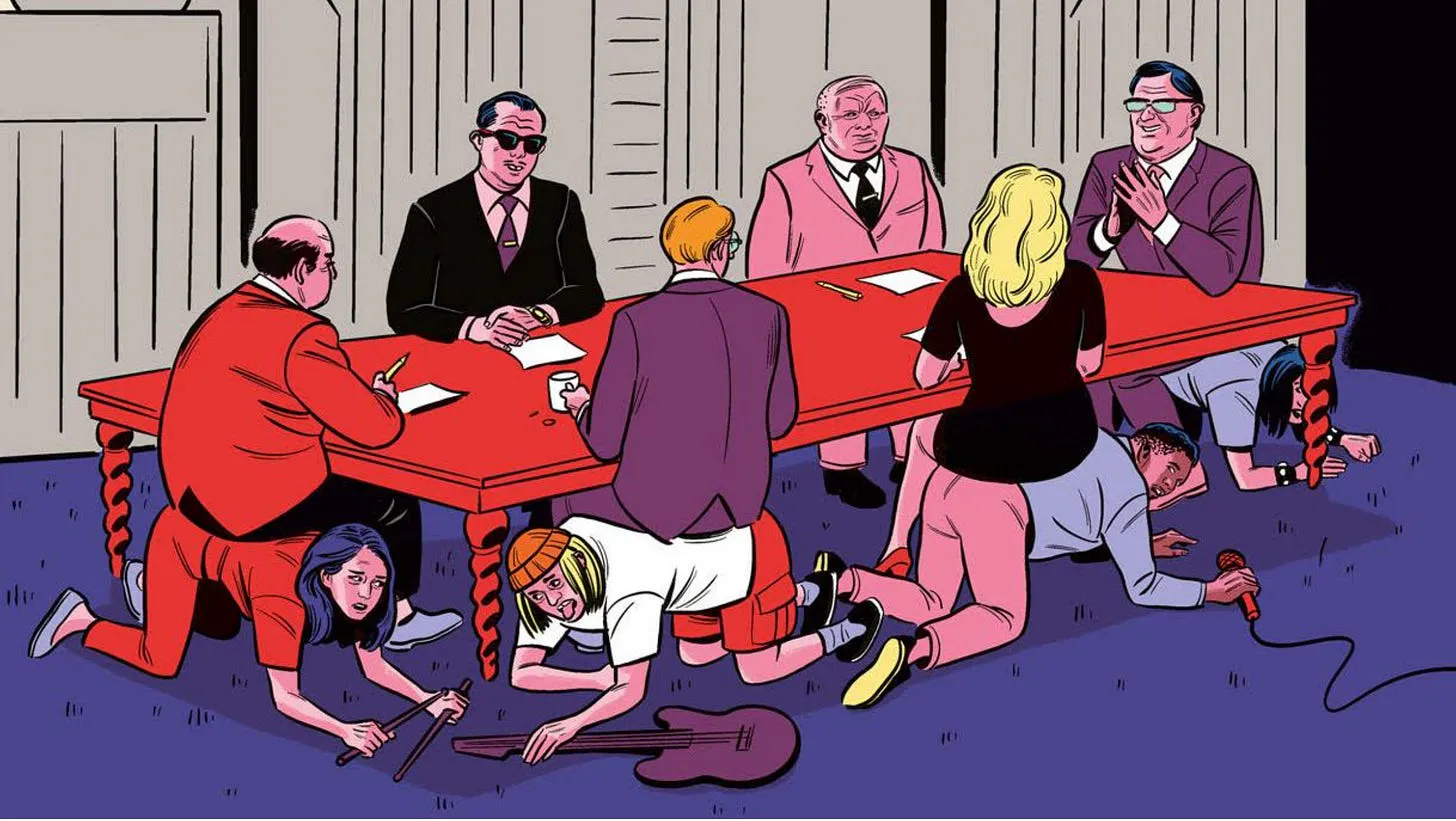
Illustration from American Prospect
Here’s how Oscar-winning film producer Chris Moore (Manchester By the Sea) put it in a recent blog post:
“How do we make a living and provide services for the subscriber-driven companies?… The subscription model means content providers are paid regularly no matter the quality and quantity of the product. Makes sense – being paid on a regular basis before you make content is awesome, but in this subscription economy, we have lost the ability to place value on each individual film. [Instead this] places more value on the content provider and its library than the quality of each individual piece of content.”
The change from valuing individual standout creative work to valuing ubiquitous libraries of always-on content has made increasing areas of culture no longer art- or hit-making businesses, but ones of mass content-creation. Chris Moore again:
“Without the hit-driven business model, there has become no way for me to continue as an independent creative producer in the same way I was before. Development money + fees + bonuses + profit participation allowed for a speculative model of finding new properties, supporting new talent, and executing other people’s stories… But those days are gone.”
We know what the world is changing from.
What we don’t know is what it’s changing to.
The paths before us
As more and more of the pillars of the 20th century stop working the way we expect, where do we turn? Already there are several competing paths for how to respond to this moment of breakdown.
- Some people want to AI all the things. Bank regulators failed to supervise Silicon Valley Bank properly, so create AI regulators to do it, then apply this argument to everything. For this crowd the answer to the increasing complexity of modern life is to put computers in charge as the ultimate systems designers and admins. (This is a terrible and extremely dangerous idea, btw.)
- Others want to metaverse all the things. Only online, say these people, will we truly be freed from the “reality privilege” enjoyed by the rich. Instead, live fully online in immersive corporate servers where you purchase all your favorite brands and be verifiably you for only $12.99 a month!
- Another group wants to incite the public to ape in and drop out into a new separatist movement of sovereign “network states” where internet groups can create their own countries, avoid US laws, and ban and cancel whomever they want.
Among some of the most powerful and influential people in the world, these seem to be the three primary arguments for where we should go from here.
None of these paths is at all appealing to me personally. Instead, the path I’m opting into is one where we evolve with change rather than fight it, while holding onto and manifesting the values that are most core to who we are.
This is the spirit behind Metalabel — an operating system for groups of creative people to release work together. It’s a form that encourages people to collaborate and support each other in their creative projects rather than compete for attention, as “Creator Economy” platforms incentivize them to.
Metalabels are not an entirely new invention. They combine the social and technological structures of the internet with the centuries-long legacy of how creative people have traditionally come together to make culture. Think of projects like the Royal Society, the Whole Earth Catalog, The Paris Review, Def Jam, Dischord Records, and countless other collective creative efforts. A metalabel is how those same kinds of projects can come into being in the internet age.
The result is a structure that amplifies the benefits (global connectivity and shared context) and counters the drawbacks (loneliness and zero-sum competitiveness) of the web, while being optimistic about what the future holds. Our format of the onchain record (or, as another record label founder called it in a conversation, “a metarecord”), is one of those expressions of optimism. Onchain records let creators bundle different forms of media into a collectible release, creating a new direct value exchange between artists and fans.
So far, four creative works have been published using the onchain record format, and the early results have been exciting.
The first onchain record
- After the Creator Economy by Metalabel sold out 200 copies of a physical zine, half via onchain records, half traditional ecommerce, while making a PDF free for anyone to download.
- The Quadratic Funding Collection by Gitcoin sold more than 9,000 editions of an onchain record that reissued an academic paper co-written by Ethereum founder Vitalik Buterin, raising more than $1 million (including royalties) for public goods in a little over a week.
- B2B: A 2 Nite Experience by the musical collective Songcamp and onchain music store Catalog sold tickets to two upcoming concerts in NYC using a record, selling out those editions in just six minutes.
- Sacred Stacks, a zine collecting work by citizen journalists around the world organized by University of Colorado professor Nathan Schneider, dropped yesterday, selling more than 200 of its 300 limited editions in its first 24 hours, directing funds to eight groups around the world.
- Each of these records represents creative people selling editions of and getting fairly paid (and/or supporting others) through their work.
By combining multiple works, kinds of work, and the creators’s contexts in one bundle, onchain records provide creators a format that reflects the multi-medium, multi-message, worldbuilding reality of releasing creative work today, while also creating a canonical record of that work’s existence. More of these Quality Drops, as we call them, will be released in the weeks and months ahead (sign up here to be notified when they do).
Not all of the groups and creators I’ve spoken with about dropping work with Metalabel are going to. For some, we’re still too out there, and I get that. But most of the people I’ve spoken with are going to. Some because they’re really excited by what we’re doing. And some who are willing to take a chance because they don’t see a better option.
At some point the old shit doesn’t work anymore. But that’s not a reason to give up. It’s a reason to make new shit that does.

The Ideaspace
Yancey Strickler's private desktop